Mathovia

Algebra / Solving Equations and Inequalities

Absolute Value Equations

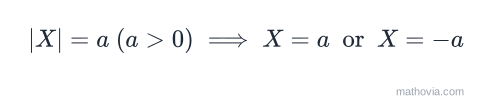
The absolute value |x| is the distance of x from zero, so |x| = a means x is a distance a from zero — which gives two possibilities, x = a and x = −a. To solve an absolute value equation you first isolate the absolute value expression, then split it into those two linear equations. This lesson covers that split and the three special cases that don't produce two ordinary solutions.

Practice Problems
M
Written by
Mathovia Team
Editorial Team

The absolute value is the distance of from zero on the number line, so it is never negative. An equation like says “the quantity is a distance of from zero” — and there are two ways for that to happen: or .

That split into two cases is the whole method. The steps around it are: isolate the absolute value first, then split, then solve each linear (or quadratic) piece with the methods you already know. Three special cases — equal to zero, equal to a negative, and absolute value equal to absolute value — are worth memorizing.

It helps to keep the definition in view. Formally,

When you write you are assuming the inside came out non‑negative; when you write you are assuming it came out negative and the bars flipped its sign. Those are the only two possibilities, which is exactly why an isolated with produces two equations and never three. Every technique in this lesson is just bookkeeping around that one fact.

The Absolute Value Equation Formula

Absolute Value Equations — key formula
Key formula

is whatever is inside the absolute value bars. When there are two cases; gives the single equation ; gives no solution.

The Method

  1. Isolate the absolute value expression — get alone on one side.
  2. Check the right side.
    • Positive: split into and .
    • Zero: solve the single equation .
    • Negative: no solution, .
  3. Solve each resulting equation.
  4. Check if the other side contains the variable.

Special Case: Equal to Zero

One solution — the two cases collapse because and are the same.

Special Case: Equal to a Negative

Distance is never negative.

Special Case: Absolute Value Equals Absolute Value

The Squaring Alternative for |A| = |B|

Because for every real number, the equation is equivalent to . Squaring both sides removes the bars entirely:

The zero‑product step recovers the same two cases, and , so squaring is not a new method — it is a check on the split. Squaring is only safe when both sides are absolute values (or both are known to be non‑negative). If one side contains a bare variable expression such as , squaring can introduce extraneous roots, so the isolate‑and‑split method with a final check is the reliable route there.

When the Split Produces a Quadratic

Nothing requires the inside of the bars to be linear. still splits into two equations, they just happen to be quadratic:

The first gives . The second gives , whose discriminant is , so it contributes no real solutions. Treat each case with whatever quadratic tool fits — factoring, the quadratic formula, or completing the square — and discard any case with no real roots.

Worked Example A: The Basic Split

Solve .

Step 1 — already isolated. Right side is positive, so split:

Step 2 — solve each:

Answer: or . Both are a distance from .

Worked Example B: Isolate First

Solve .

Step 1 — isolate the absolute value:

Step 2 — positive right side, split:

Step 3 — solve each:

Answer: or .

Worked Example C: Variable on Both Sides

Solve .

Step 1 — split:

Step 2 — solve each:

Step 3 — check both (the right side must be ):

  • : and . ✓
  • : but . . ✗ extraneous

Answer: only.

Worked Example D: Absolute Value Equals Absolute Value

Solve .

Split into and :

Solve each:

Check: : . ✓ : . ✓

Answer: or .

Worked Example E: A Quadratic Inside the Bars

Solve .

Step 1 — already isolated, right side positive, split:

Step 2 — solve each case as a quadratic:

Step 3 — check the real candidates in the original equation:

  • : . ✓
  • : . ✓

Answer: or .

Common Mistakes to Avoid

  • Splitting before isolating. is not or ; first get .
  • Only writing one case. with always produces two equations.
  • Reporting an answer when the right side is negative. has no solution — do not split it.
  • Forgetting the check when the variable is on both sides. A candidate can make the right side negative, which invalidates it.
  • Distributing the negative to only one term. In case two, is , not .
  • Dropping the ”” single solution. has exactly one solution, not zero and not two.

Where This Shows Up Later

  • Absolute Value Inequalities. and use the same “inside is a distance” idea, turned into compound inequalities.
  • Distance on the number line and in the plane. is the distance between and ; equations set that distance to a value.
  • Piecewise functions. is the piecewise function for and for ; the two cases here are those two pieces.
  • Error bounds and tolerances. “The measurement is within of ” is at the boundary.

Practice Problems

Work each problem yourself before opening the answer.

Problem 1. Solve .

Show answer

Problem 2. Solve .

Show answer

Problem 3. Solve .

Show answer

Problem 4. Solve .

Show answer

Isolate: , so , giving (one solution).

Problem 5. Solve .

Show answer

An absolute value can’t be negative. No solution, .

Problem 6. Solve .

Show answer

, so or , giving or .

Problem 7. Solve .

Show answer

or , giving or .

Problem 8. Solve .

Show answer

, so or , giving or .

Problem 9. Solve .

Show answer

; .

Check: : and . ✓ : but . ✗

Answer: .

Problem 10. Solve .

Show answer

; .

Both check. Answer: or .

Problem 11. Solve .

Show answer

Split: or .

First: .

Second: , discriminant , no real solution.

Answer: or .

Problem 12. Solve two ways — by splitting and by squaring — and confirm they match.

Show answer

Split: ; .

Square: .

Both routes give or .

Quick Reference

Right side after isolatingResult
positive or (two solutions)
(one solution)
negativeno solution,
or
variable also on the right sidesolve both cases, then check
alwaysisolate the absolute value before splitting

Each split case is a Linear Equation (or occasionally a quadratic). The inequality companion is Absolute Value Inequalities. More Algebra lessons are available too.

Frequently Asked Questions

How do I solve an equation with an absolute value in it?+

Isolate the absolute value expression on one side. If it equals a positive number , split into two equations: (inside) and (inside) . Solve both. If it equals zero, there is one equation; if it equals a negative, there is no solution.

Why does |x| = a give two answers?+

Absolute value measures distance from zero, and two different numbers, and , are each a distance from zero. is true for and for .

What if the absolute value equals a negative number?+

There is no solution. An absolute value is a distance, so it is never negative. has no solution, and the answer is the empty set .

Do I have to isolate the absolute value before splitting?+

Yes. must first become ; only then do you split into and . Splitting before isolating gives wrong equations.

How do I solve |A| = |B|, absolute value equal to absolute value?+

Split into and . These two cases cover the possibility that the insides are equal or opposite. Solve both and check.

Do I need to check answers to an absolute value equation?+

It is good practice, especially when the other side of the equation contains the variable, like . In that case a candidate can satisfy one split case but make the original right side negative, which is impossible, so it must be discarded.

Can I solve |A| = |B| by squaring both sides?+

Yes. Since , the equation is equivalent to , which factors as and returns the same two cases and . Squaring is safe only when both sides are absolute values; if one side is a plain variable expression, square with caution and check for extraneous roots.

What if there is a quadratic inside the absolute value bars?+

The method does not change. Isolate , then split into and ; each case is now a quadratic that you solve by factoring or the quadratic formula. Discard any case whose discriminant is negative, since it has no real solutions, and check the survivors in the original equation.

Related lessons